
You've decided to build a 22 ARC, 6 ARC, or 338 ARC. Great! Now your problems begin.
The problem isn't with the cartridges themselves — all three have earned their reputations and their SAAMI approvals. The problem is that the most consequential dimension on the bolt that feeds them, the bolt face depth, isn't actually specified by SAAMI, and never has been. Build around a bolt where that number is wrong, or where the related dimensions don't add up, and the consequences range from pierced primers and broken extractors to brass flying rearward in a way that tends to end a range session early.
And sorting out which bolts are correct turns out to be considerably harder than it should be.
SAAMI Doesn't Spec the Bolt
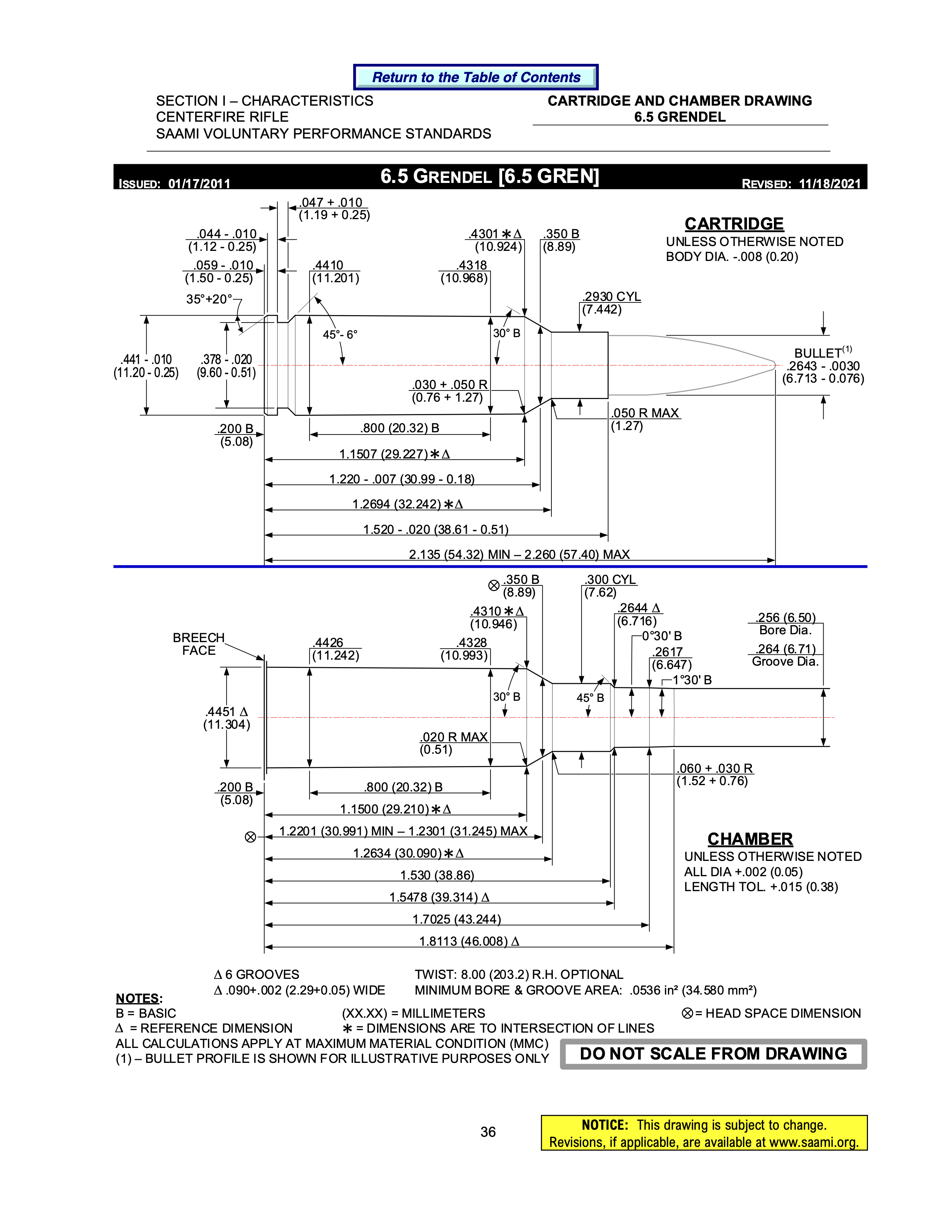
Below is the SAAMI drawing for 6.5 Grendel, which also governs the chamber that every Grendel-family cartridge — 6.5 Grendel, 6mm ARC, 22 ARC, and 338 ARC — headspaces into.
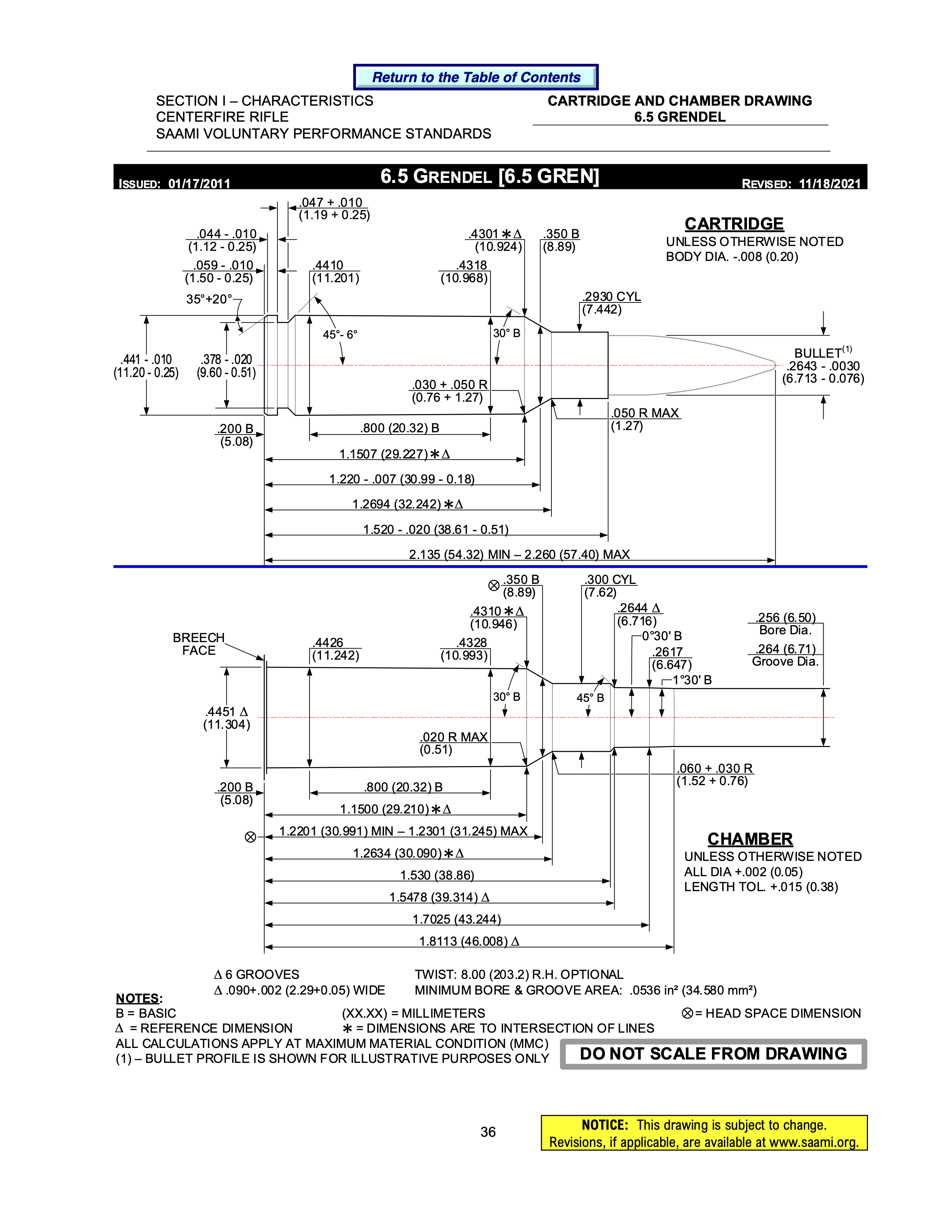
The drawing covers what you'd expect from a cartridge standard: cartridge dimensions across the top half, chamber dimensions across the bottom, a labeled "BREECH FACE" reference plane, and headspace marked by the ⊗ symbol at 1.2201" to 1.2301" from that plane to the shoulder datum. Throat, neck, body taper, shoulder angle, bullet profile — all of it is there. What isn't there is any dimension for the bolt itself, meaning no bolt face depth, no bolt length, and no firing pin hole diameter.
That omission is by design rather than oversight. SAAMI Z299.4 is a voluntary industry standard for cartridges and chambers only, and bolt geometry has always been left to firearm manufacturers. For most cartridges this isn't a problem, because bolt geometry was effectively standardized decades ago and new entrants simply copy the mil-spec dimensions the industry settled on. For 6.5 Grendel and the ARC cartridges descended from it, the situation is different — because the engineer who designed the cartridge also had to invent the bolt that runs it, and he never gave the rest of us a published tolerance to work from.
Enter Alexander Arms
When Bill Alexander introduced the 6.5 Grendel in 2003, he designed a new AR-15 bolt to match it. Standard 5.56 AR-15 bolts have a bolt face depth of 0.125"; Alexander went deeper, to 0.136", for two reasons. The first was practical: Lapua-made Grendel brass has a thicker rim than 5.56, and a standard 5.56 extractor couldn't reliably snap over it. Deepening the bolt face allowed him to fit a larger, stronger extractor without redesigning the pivot geometry. The second was structural — the larger case head simply needed more support in the bolt recess than a 5.56-depth well could provide.
That is the entire origin story of the 0.136" dimension. It did not come from SAAMI or from an industry working group; it came from one engineer solving a specific extraction problem in Radford, Virginia, and being the only person in a position to decide what the answer would be. Alexander Arms's own product page for their 6.5 Grendel bolt assembly describes it as having a "0.136-inch bolt face recess," and the company has never published an accompanying tolerance. The dimension exists; a tolerance band around it does not.
Type 1 vs Type 2
When Alexander Arms's trademark on the "Grendel" name created licensing headaches for other manufacturers, the industry split. Some companies paid the royalty and adopted Alexander's 0.136" bolt face depth, which became known in the aftermarket as the "Type 2" bolt. Others, led by Les Baer Custom, re-engineered the chamber to work with a shallower 0.125" bolt face — essentially a 5.56-depth bolt paired with a longer extractor — and sold the cartridge under alternate names such as ".264 LBC." These are the "Type 1" bolts.
The result is a cartridge with no official bolt spec, two different bolt face depths sold under overlapping names, and no agreed-upon tolerance for either. The industry eventually consolidated around Type 2 (0.136") for 6.5 Grendel and all the ARC cartridges that followed, but Type 1 barrels and bolts still surface on the used market. If you have a mystery barrel, you have to verify which one you have before you buy a bolt for it.
The Depth Question
Because Alexander Arms never published a tolerance, every bolt manufacturer has quietly set its own, and the communities that care about this stuff have spent years trying to back into an answer from their own calipers. A representative r/65Grendel thread starts with a builder reporting his brand-new bolt measuring 0.140" instead of 0.136" and asking whether anyone else has seen odd numbers. The replies land in very different places. One poster with an AIM Surplus Type 2 bolt that runs both steel- and brass-cased Grendel reports actually measuring his:
"My AIM Surplus Type 2 6.5 Grendel bolt, which works with both steelcase and brass case 6.5 Grendel ammo, measured out 0.138-0.135 depending on which lug, so 0.136 +/-0.002 it seems? Might also be the small radius between bolt face and the wall around it impacting measurements."
Others in the same thread reject the whole framing, arguing that bolt face depth taken in isolation isn't even the right dimension to be arguing about:
"How about the bolt lug length? If those are longer than normal by a couple thousandths the relationship between locking lug surface and bolt face is about the same. The bolt face depth alone isn't what sets headspace. You could turn the rim off the bolt face and it wouldn't affect headspace measurements."
That second point is technically correct. Headspace is set by the distance from the locking shoulder to the bolt face, and lug length can compensate for a deeper face in ways that the depth number alone doesn't capture. In practice, though, depth is the only dimension the end consumer can meaningfully measure without pulling the barrel, which is why it's the number bolt makers advertise and builders argue about. Actual measured samples bear out a working tolerance of roughly ±0.002": depths reported in the wild range from 0.1340" to 0.1380" depending on manufacturer, and Toolcraft — a popular budget bolt maker — has shipped bolts at 0.1375", technically outside the tightest published tolerance but accepted in practice by most builders.
That would be the end of the conversation if bolt face depth were the only dimension that mattered, but it isn't.
The Length Question
A standard mil-spec AR-15 bolt measures 2.800" from the rear face of the bolt tail to the outermost face of the bolt, and a mil-spec firing pin measures 3.280" ± 0.001". Together, those two dimensions produce firing pin protrusion of 0.028" to 0.036" — the acceptable range that prevents both light strikes and pierced primers.
When Alexander Arms deepened the bolt face by 0.010", they faced a choice between two paths. They could shorten the firing pin by 0.010" to preserve correct protrusion, or they could lengthen the bolt by 0.010" so that a standard mil-spec firing pin would still work. Alexander chose the latter. An Alexander Arms-spec Grendel bolt measures 2.810" overall and uses the standard mil-spec firing pin, because the 0.010" of added bolt length compensates exactly for the 0.010" of added bolt face depth. The geometry balances.
Not every manufacturer followed suit. Several aftermarket makers deepened the bolt face to 0.136" but left the bolt at 2.800" — the standard 5.56 length — and shipped it with a standard 3.280" firing pin. The result is roughly 0.010" of excess firing pin protrusion, putting the assembled rifle in the 0.038" to 0.046" range, above the mil-spec maximum, with predictable consequences: pierced primers on chambering, slam-fire risk, and accelerated firing pin tip wear.
Toolcraft has shipped bolts in exactly this configuration, and at least one other budget maker has as well. Some ship a shortened firing pin to compensate; others simply don't mention the issue. The forum threads on 65grendel.com and r/65Grendel are populated with builders trying to understand why their new Grendel started piercing primers within the first hundred rounds, and the diagnosis almost always comes back to a 2.800" bolt paired with a 0.136" face depth and a standard-length firing pin. It is exactly the kind of failure mode that wouldn't occur if SAAMI specified the bolt.
So What Do You Actually Buy?
If you're building a 6.5 Grendel, 6 ARC, 22 ARC, or 338 ARC today, the specification that actually works is as follows:
- Bolt face depth: 0.136" ± 0.002" — Alexander Arms nominal, with the reasonable manufacturing tolerance the aftermarket has converged on.
- Bolt overall length: 2.810" — the full 0.010" extension that keeps the firing pin math in balance.
- Firing pin: standard mil-spec, 3.280" ± 0.001".
- Firing pin protrusion after assembly: 0.028"–0.036", verified with a Brownells-type protrusion gauge before the rifle goes to the range.
Any bolt advertised as "Type 2" or ".136" and matching those four numbers will run correctly in a SAAMI-spec chamber in any of the Grendel-family cartridges. Any deviation — and particularly a 2.800" overall length paired with a 0.136" face depth — requires either a shortened firing pin or a return label. None of this is specified by SAAMI, and probably should be. Until it is, the verification falls to you.