
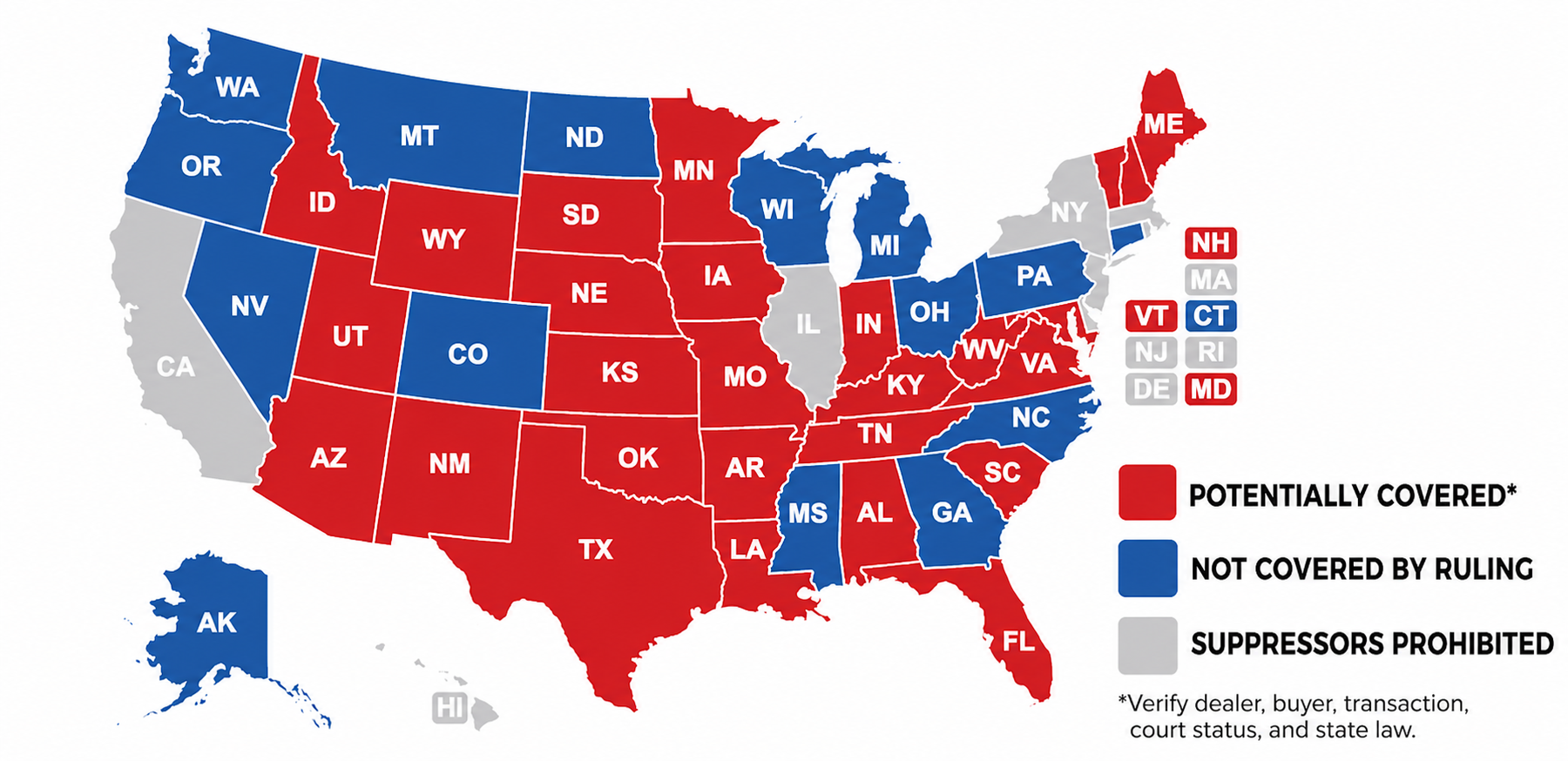
Good news for qualifying FFL/SOT dealers: the August 5, 2026 federal ruling may now provide a lawful path to sell certain suppressors without waiting for an approved Form 4. The opportunity is real—but it is narrow and transaction-specific. This guide walks you through the checks the dealer, customer, suppressor, and state must clear before anything leaves inventory.
For an independent dealer, the critical language appears on pages 60–61 of the court’s Memorandum Opinion: the injunction reaches the current and future customers of the associational plaintiffs’ commercial members for transactions with those commercial members. That creates a potential route beyond Silencer Shop and Palmetto State Armory—but only when the dealer, customer, suppressor, and transaction all fit within the injunction.
What the Court Actually Enjoined
The case is Silencer Shop Foundation v. ATF, consolidated with Jensen v. ATF. In Document 136, the court explains that 27 C.F.R. §479.84(a) is the regulation requiring the transferor to submit the application commonly known as ATF Form 4. Section 479.84(b) and 26 U.S.C. §5812(a) impose the accompanying transferee-information requirements, while §5812(b) ordinarily prevents possession before ATF approves the application.
The operative Final Judgment, Document 137, permanently enjoins ATF, DOJ, and their personnel from enforcing specified provisions against the protected parties as to untaxed firearms. Those provisions include:
- 26 U.S.C. §5812(a)–(b) and 27 C.F.R. §479.84(a)–(d), which supply the federal Form 4 application, information, approval, and possession-before-approval requirements.
- 26 U.S.C. §5841(a)–(c), (e), covering the National Firearms Registration and Transfer Record provisions identified by the judgment.
- 26 U.S.C. §5861(b)–(f), covering specified offenses tied to unlawful receipt, possession, transfer, making, and registration.
The associational plaintiffs are Gun Owners of America, Gun Owners Foundation, the Firearms Regulatory Accountability Coalition, Texas State Rifle Association, FPC Action Foundation, and the Citizens Committee for the Right to Keep and Bear Arms. The judgment protects the plaintiffs and, where applicable, their agencies, political subdivisions, members, and customers—both current and future.
Membership can therefore matter, but a membership card is not a federal suppressor license. It is evidence that a person or business may fall within a protected relationship. The actual member, the legal entity named in the transaction, and the transaction itself still have to match the injunction.
The Independent FFL/SOT Route
Pages 60–61 of Document 136 are the core of the independent-dealer argument. The court considered the named commercial plaintiffs’ customers and applied the same reasoning to the customers of the associational plaintiffs’ commercial members. It concluded that current and future customers must be protected for their transactions with those businesses.
Plaintiff association → qualifying commercial member → customer’s transaction with that commercial member.
The limitation matters just as much as the protection. Customer status does not create permanent NFA immunity, and a buyer’s individual membership does not automatically protect an unrelated dealer. The coverage is tied to the protected relationship involved in the particular transaction.
This language supplies a serious textual basis for independent dealers to participate. It is not an ATF implementation program, an automatic safe harbor, or a guarantee that every membership product sold to a business qualifies as “commercial membership” under the opinion. Neither the court nor the associations’ current public pages expressly define every TSRA Business/Club or GOA Caliber Club participant as a covered commercial member for this judgment. The dealer should obtain that conclusion in writing from the association and its own counsel before relying on it.
Why This Guide Is for FFL/SOTs Only
The conservative answer is stronger than “an SOT is probably safer.” This guide should be limited to dealers that hold both the appropriate federal firearms license and current Special Occupational Tax status.
The Final Judgment does not enjoin 26 U.S.C. §5801, which imposes the special occupational tax on importers, manufacturers, and dealers in NFA firearms. It also does not enjoin §5861(a), which prohibits engaging in that business without having paid the occupational tax.
A suppressor remains a firearm under federal law even when its transfer tax is zero and the specified Form 4 provisions are enjoined for a protected transaction. An FFL without an active SOT should not use this theory to begin dealing in suppressors. It should obtain the appropriate SOT or decline the transaction.
The same principle applies to inventory. The injunction is not permission to acquire off-book suppressors or accept suppressors from unauthorized sources. Every unit should enter the dealer’s inventory through the normal lawful licensed channel, with its acquisition and identifying information properly recorded.
Build More Than One Membership Connection
A defensible program begins on the dealer side. The strongest practical approach is to establish more than one documented relationship with plaintiff associations, while recognizing that several memberships cannot cure a relationship that the association itself will not confirm.
1. TSRA Business/Club Membership
The Texas State Rifle Association is an associational plaintiff in Jensen, and its public membership system offers a Business/Club membership. This is the clearest publicly available TSRA commercial-membership route and should be the independent dealer’s first call.
Enroll the exact legal entity named on the FFL—not only an owner, employee, trade name, or unrelated holding company. Then request written confirmation that:
- the licensed entity is a current TSRA member;
- TSRA treats that membership as a commercial or business membership;
- TSRA understands that the request concerns the “commercial members” language on pages 60–61 of Document 136; and
- TSRA considers the dealer and its current and future customers within the relationship described by the court.
A certificate and membership card are useful evidence, but the label “Business/Club” does not, by itself, conclusively answer the litigation-specific question. Preserve the association’s written answer and have counsel evaluate it.
2. GOA Caliber Club
Gun Owners of America is another named associational plaintiff. GOA’s Caliber Club is its public partnership program for gun stores and ranges, and GOA describes its participants as members. That makes it another logical dealer relationship to pursue.
The public program description alone is not enough for this particular injunction. Ask GOA to confirm in writing that the dealer’s exact legal entity is treated as a commercial member for purposes of Document 136 and the Final Judgment. Keep the enrollment record, current-status evidence, and GOA’s response in the dealer’s program file.
3. FRAC Member-Company Status
The Firearms Regulatory Accountability Coalition is a plaintiff industry association whose system distinguishes member-company dues from ordinary donations. A dealer or related industry business that is eligible can seek member-company status and the same written, case-specific confirmation.
A donation is not membership. A newsletter subscription is not membership. An advocacy partnership is not necessarily membership. The relevant question is whether the association recognizes the licensed dealer entity as one of its commercial members within the relationship addressed by the court.
4. Buyer-Side Memberships
If the dealer is a confirmed commercial member, Document 136 says its current and future customers are protected for transactions with that dealer. Under that theory, a customer may derive coverage from the transaction without independently joining another organization.
Even so, an individual membership in GOA, TSRA, or CCRKBA provides useful additional evidence and avoids making the file depend on only one relationship. A conservative written policy may require a natural-person buyer to maintain current membership in at least one of those named plaintiff associations and may recommend membership in more than one.
Do not confuse similarly named organizations. Ordinary Firearms Policy Coalition membership is not necessarily membership in the separate FPC Action Foundation plaintiff, and donating to Gun Owners Foundation does not necessarily establish member status. NRA, SAF, and ASA membership alone is not membership in a plaintiff association covered by this judgment.
There is also an entity problem. If the customer’s membership belongs to John Smith but the proposed transferee is the Smith Family Trust, Smith Holdings LLC, or another corporation, the member and transferee are not necessarily the same legal person. Unless the association and the dealer’s attorney expressly confirm entity coverage, the conservative policy is to restrict this program to natural-person transferees whose identity matches the membership evidence.
The No-Form-4 Decision Gate
A dealer should not improvise this at the counter. Adopt a written policy approved by counsel, then require a documented “yes” at every gate before the suppressor leaves inventory:
- Dealer status: Is the exact selling entity an active FFL with the appropriate current SOT?
- Lawful inventory: Was the suppressor acquired through the normal licensed channel and properly entered in the dealer’s records?
- Current court status: Has counsel verified that the Final Judgment is presently effective and that no appellate or district-court stay, modification, or superseding order prevents reliance on it?
- Dealer coverage: Does the dealer have current documentary evidence and written association confirmation that its legal entity is a qualifying commercial member of a plaintiff association?
- Transaction coverage: Is this customer purchasing directly from that covered commercial member, creating the transaction-specific relationship described on pages 60–61?
- Customer identity: Does the purchaser’s government-issued identity match the intended transferee and any buyer membership being relied upon?
- State and local law: Has counsel confirmed that the purchaser’s jurisdiction does not independently require federal registration, an approved Form 4, or another authorization, and does not prohibit the suppressor?
- GCA compliance: Can the dealer complete Form 4473, identification, NICS or a valid exception, prohibited-person review, and every other applicable Gun Control Act requirement?
- Written legal approval: Does the completed transaction fit the dealer’s attorney-approved procedure without an unresolved exception?
If any answer is “no,” “unclear,” or “we think so,” do not use the no-Form-4 process. Use the ordinary approved process or decline the sale.
Form 4 Is Not Form 4473
The litigation concerns specified portions of the tax-based Title 26 NFA system. It does not enjoin the ordinary Title 18 Gun Control Act dealer rules.
- ATF Form 4 is the NFA transfer and registration application addressed by 26 U.S.C. §5812 and 27 C.F.R. §479.84.
- ATF Form 4473 remains the dealer’s firearm transaction record for a disposition to a nonlicensee.
- NICS, a state point-of-contact check, or a legally valid exception remains required as applicable.
- Identification, residency, age, prohibited-person, and state requirements remain applicable according to their own terms.
- The dealer’s acquisition-and-disposition record must still show the suppressor’s lawful acquisition and disposition.
“No Form 4” therefore means no reliance on the enjoined NFA transfer application and preapproval provisions for a protected transaction. It does not mean no background check, no identification, no serial-number record, or an off-book sale.
Build a Permanent Program File
Before conducting the first transaction, create a dealer-level program file containing:
- the dealer’s current FFL and SOT evidence;
- membership applications, receipts, cards, certificates, and renewal dates for every commercial association relationship;
- written association confirmation identifying the licensed legal entity and addressing commercial-member status under Document 136;
- a written opinion or policy approval from qualified firearms counsel;
- dated copies of Document 136 and the Final Judgment, Document 137;
- the results and date of counsel’s docket and stay-status review;
- a state-law matrix or transaction-jurisdiction procedure approved by counsel; and
- the written counter procedure and employee training record.
Reverify the dealer’s membership and the judgment’s status periodically and immediately after any material court development. Membership that expired before the transaction is not evidence of current commercial-member status.
Build a Transaction Packet for Every Sale
Every no-Form-4 transfer should have its own secure packet, cross-referenced to the suppressor’s serial number, Form 4473, and A&D disposition. At minimum, retain:
- the purchaser’s exact legal name and the identity of the actual transferee;
- the dealer’s qualifying association and current commercial-membership number or identifier;
- a dated verification of the dealer’s active membership status;
- the buyer’s GOA, TSRA, CCRKBA, or other plaintiff-association membership evidence if buyer membership is being used;
- the buyer membership number, status, expiration date, verification date, and verification method;
- a copy or saved association confirmation rather than a counter employee’s undated note;
- the invoice, manufacturer, importer if applicable, model, serial number, type, and caliber or gauge information;
- the completed Form 4473 and NICS or state point-of-contact transaction information, including the final response or valid exception;
- the corresponding A&D record reference;
- the applicable state-law determination and the date it was checked;
- the version of the dealer’s attorney-approved checklist used for the sale; and
- a dated employee sign-off showing that every decision gate was satisfied before disposition.
Keep the custom eligibility packet separate from—but cross-referenced to—the required Form 4473 and A&D records. Record only the membership information needed to prove status. Do not collect association account passwords or unrelated profile data. Store copies in a restricted compliance system with encryption, access controls, backups, and an audit trail. Membership evidence contains customer information and should not be left in an open sales folder or repurposed for marketing without separate permission.
Keep the Records for the Life of the Business
The old shorthand that a dealer can discard all records after 20 years is not the current rule. Under 27 C.F.R. §478.129, FFLs must retain Forms 4473 and dealer acquisition-and-disposition records until the business or licensed activity is discontinued. Qualifying paper records older than 20 years may be stored at a separate warehouse, but that does not make them disposable. Required records are delivered to ATF when the business is absolutely discontinued under §478.127.
ATF proposed a new rule on May 6, 2026 that would replace indefinite retention with a definite period of either 20 or 30 years. The comment period closed August 4, but a proposal is not a final rule. Unless and until a final rule takes effect, the current life-of-business requirement controls.
The association confirmations, membership verifications, legal analyses, injunction-status checks, and transaction checklists described above are not all ATF-required Form 4473 or A&D fields. Retaining that custom packet for the same life-of-business period is a risk-management recommendation, not an ATF mandate. It is nevertheless the evidence explaining why the dealer concluded that no Form 4 was required, and SWP recommends keeping it for the life of the licensed business even if a future regulation permits earlier destruction of ordinary records.
The Bottom Line
The court’s language is broader than Silencer Shop and PSA. It expressly contemplates current and future customers of the associational plaintiffs’ commercial members, giving an independent dealer a potential path to conduct a covered suppressor transfer without the federal Form 4 process.
Active FFL/SOT + lawfully acquired inventory + written confirmation of commercial-member status + a customer transaction with that member + current court-status review + no conflicting state law + full Form 4473/NICS/A&D compliance + permanent supporting records.
TSRA’s Business/Club membership is the clearest place to start, followed by GOA’s Caliber Club and FRAC member-company status where eligible. Dealer and buyer memberships in multiple plaintiff associations add useful redundancy, but no card or dues receipt replaces written association confirmation and transaction-specific legal review.
Sources
- Silencer Shop Foundation v. ATF, Memorandum Opinion, Document 136 (Form 4 at pages 5–6; GCA/NFA distinction at pages 45–46; commercial-member customers at pages 60–61).
- Silencer Shop Foundation v. ATF, Final Judgment, Document 137, pages 1–2.
- Public case docket, checked through Entry 139 on August 14, 2026.
- TSRA, August 13 injunction status update.
- 26 U.S.C. §5801, Special Occupational Tax.
- 26 U.S.C. §5812, Transfers.
- 26 U.S.C. §5861, Prohibited Acts.
- 27 C.F.R. §478.124, Firearms Transaction Record.
- 27 C.F.R. §478.125, dealer acquisition-and-disposition records.
- 27 C.F.R. §478.129, current record retention.
- 27 C.F.R. §478.127, discontinued-business records.
- ATF, Federal Firearms Licensee Quick Reference and Best Practices Guide.
- ATF, proposed 20- or 30-year firearm-record retention periods, released May 6, 2026.
- TSRA, membership options including Business/Club.
- GOA, Caliber Club dealer and range program.
- Firearms Regulatory Accountability Coalition and its distinction between member-company dues and donations.
- CCRKBA, individual membership.